
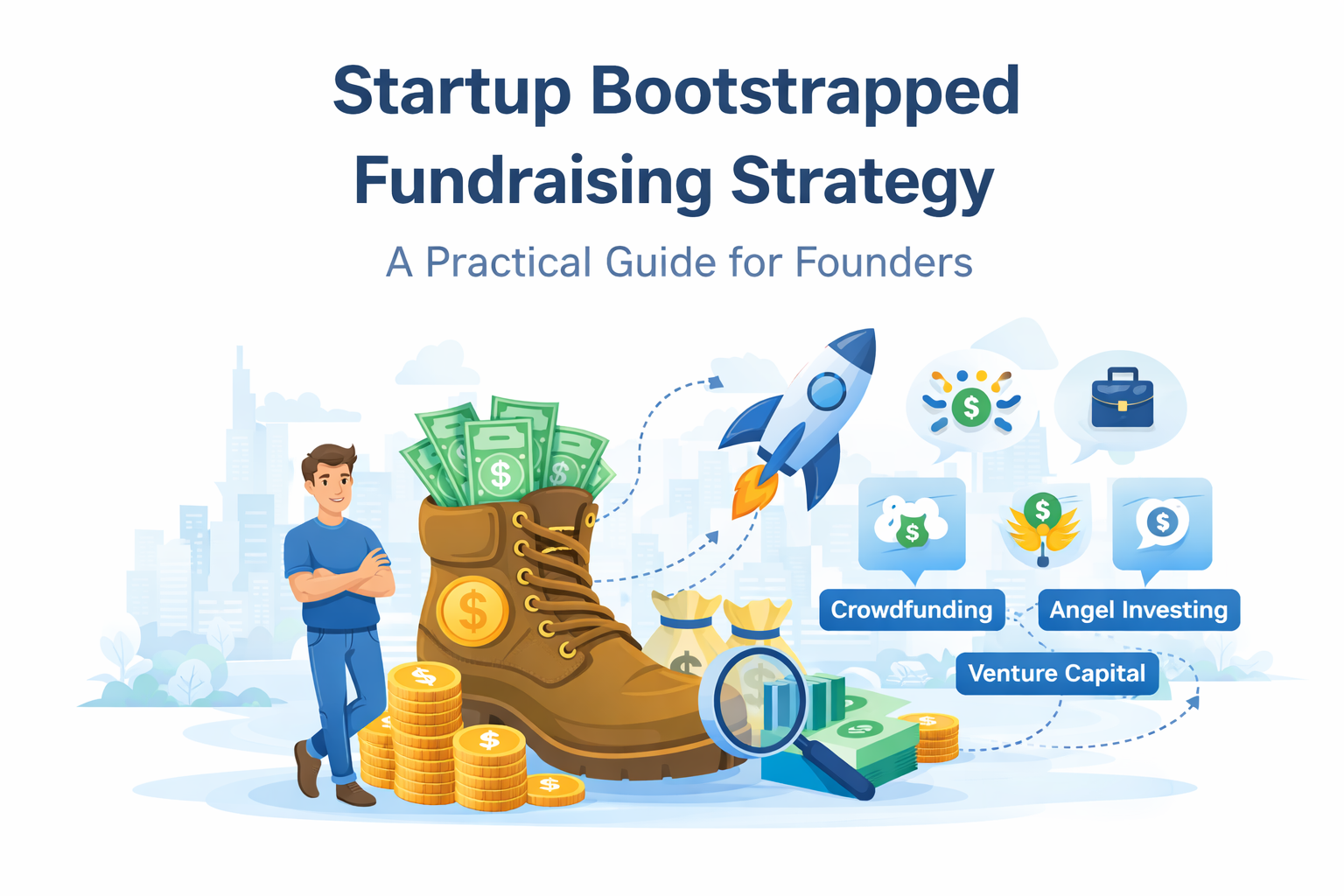
Introduction
Starting a startup is something many people think about today. New ideas come up every day, and more people want to build their own business. But once the excitement of the idea settles down, one practical question appears very quickly — how will the startup be funded?
A common belief is that startups need investors right from the beginning. Because of this, many founders start looking for funding even before their product or business model is fully ready. In reality, a large number of successful startups did not begin that way.
Instead, many founders started small. They used their personal savings, kept expenses low, and focused on getting their first paying customers. The money earned from those early customers was then used to grow the business further. This approach is usually called bootstrapping.
When founders build and stabilize their business first and think about raising investment later, it becomes part of what is often described as a bootstrapped fundraising strategy. The idea is simple: prove that the business works before bringing in outside capital.
In this article, we’ll look at this concept in simple terms. You’ll learn what bootstrapped startups are, what fundraising actually means, and how many startups use this strategy to grow step by step.
What Is a Bootstrapped Startup
A bootstrapped startup is a business that is started and grown without outside investors. Instead of raising money from venture capitalists or angel investors, the founders use their own savings, personal income, or the money the business starts earning in its early stages.
In simple terms, bootstrapping means building a business using your own resources. The startup focuses on managing expenses carefully and using the revenue it generates to keep growing.
For example, imagine a founder who starts a business with $3,000–$4,000 from personal savings. Once the startup begins making some income, that money is reinvested back into the business. Over time, the company grows step by step using its own revenue.
One major advantage of a bootstrapped startup is that the founder keeps full control of the business. Since there are no external investors involved, the founder doesn’t have to give away equity or depend on investor decisions.
Many well-known companies actually began this way. Businesses like Mailchimp, Zoho, and Basecamp started by focusing on their own resources and growing the business gradually before taking any outside funding.
What Is Fundraising for Startups
Fundraising simply means raising money to grow a startup. When a startup needs to build a product, hire a team, or spend on marketing, it often requires additional capital. The process of collecting this money from different sources is called fundraising.
Startups usually raise funding from several places. In the early stage, some founders get support from friends and family. If the business shows strong potential, outside investors may also become interested. These investors can include Angel Investors and Venture Capital Firms.
The main goal of fundraising is to give a startup the financial support it needs to grow faster. With additional capital, companies can expand their team, improve their product, and reach more customers.
However, raising funding usually means that founders must give a portion of their company ownership (equity) to investors. Because of this, many startups prefer to grow their business through bootstrapping in the beginning. Once their product and market position become stronger, they may then choose to raise funding in a more strategic way.
What Is a Bootstrapped Fundraising Strategy
A bootstrapped fundraising strategy is an approach where a startup first builds the business using its own money and early revenue, and only looks for investors later if additional funding is needed.
In this strategy, founders focus on creating a strong foundation before raising outside capital. They work on developing the product, attracting early customers, and generating revenue. Once the startup proves that the product works and there is real demand in the market, raising investment becomes much easier.
One major advantage of this approach is that the startup is in a stronger position when it finally raises funding. Since the business already has traction, founders often don’t need to give away a large portion of equity, and the company may also receive a better valuation.
In simple terms, a bootstrapped fundraising strategy means building the business first and raising funding later when the growth opportunity becomes clear. This approach allows founders to keep more control over their company while still having the option to bring in capital for future expansion.
Why Many Startups Prefer Bootstrapping First
Many founders prefer to start their startups through bootstrapping. The main reason is that when a business grows using personal funds and early revenue, founders usually have greater control over the company.
One of the biggest advantages is that founders do not have to give away a portion of their company (equity) to investors in the early stages. This allows them to make important decisions on their own and focus on their long-term vision without outside pressure.
Another benefit of bootstrapping is that it encourages founders to focus on real customers and sustainable revenue from the beginning. When a business starts running on the income it generates, the foundation of the startup becomes much stronger.
In addition, once a startup becomes stable and starts showing real traction with customers and revenue, investors often become more interested. At that point, the startup may receive better valuation and more favorable funding opportunities.
For this reason, many successful founders choose to build their business through bootstrapping first and consider raising external funding only when it becomes truly necessary.
Step-by-Step Bootstrapped Fundraising Strategy
In a bootstrapped fundraising strategy, a startup first builds and grows the business using its own resources. Once the company becomes stable and shows real potential, the founders may then decide to raise external funding. Let’s look at this process step by step.
1. Start With a Small Budget
Most bootstrapped startups begin with a limited budget. This money often comes from personal savings or a small amount of initial capital. At this stage, the goal is to keep costs low and avoid unnecessary expenses while getting the business started.
2. Build a Minimum Viable Product (MVP)
After starting the business, the next step is to create a Minimum Viable Product, often called an MVP. This is a simple version of the product that includes only the core features. The purpose is to launch quickly, test the idea in the market, and gather feedback from real users.
3. Get Early Customers
Once the product is ready, the focus shifts to attracting the first customers. Founders often rely on basic marketing, networking, and direct outreach to bring in early users or clients. These early customers are important because they help validate the product.
4. Generate Revenue
Revenue plays a key role in bootstrapped startups. As the business begins earning money, that income is usually reinvested back into the company to support further growth and development.
5. Prove the Business Model
At this stage, the startup works on proving that the business model actually works. This means showing that there is real demand for the product, customers are willing to pay, and the business has the potential to become sustainable.
6. Raise Funding at the Right Time
Once the startup has customers, revenue, and visible growth, founders may start pitching their business to investors such as Angel Investors or Venture Capital Firms. Raising funds at this stage is usually more effective because the startup has already proven its value in the market.
Real Examples of Bootstrapped Startups
Many well-known companies around the world actually started as bootstrapped startups. Instead of relying on investors in the early days, the founders focused on building their businesses using their own resources and the revenue the company generated.
1. Mailchimp
Mailchimp is a widely used email marketing platform that helps businesses create and manage email campaigns. The founders built the company without taking outside funding for many years. Because the business was bootstrapped, they were able to grow the company on their own terms and maintain full control over its direction.
2. Zoho
Zoho is a well-known software company that provides tools like CRM, email services, and many other business applications. The company followed a bootstrapping approach in its early years, focusing on building products and reinvesting profits back into the business. Today, Zoho has become a globally recognized technology company.
3. Basecamp
Basecamp is a project management tool used by teams to organize tasks and collaborate on projects. The company was initially built using a bootstrapped model, focusing on creating a simple and useful product. Over time, it became a popular software solution used by businesses around the world.
These examples show that when startups focus on building a strong product and serving real customers, it is possible to grow a successful business even without early external funding.
Challenges of Bootstrapped Fundraising
The bootstrapped fundraising strategy has many advantages, but it also comes with a few challenges. When a startup grows without external funding, founders may face several practical difficulties along the way.
1. Limited Capital
One of the biggest challenges for bootstrapped startups is limited capital. Since the business is running on the founder’s savings or early revenue, the available budget can be quite small. Because of this, expanding the business quickly may sometimes be difficult.
2. Slower Growth
When a startup does not have a large budget, activities like marketing, hiring, and product development may take more time. As a result, bootstrapped startups often grow more slowly compared to companies that receive large investments from sources like Angel Investors or Venture Capital Firms.
3. High Pressure on Founders
In many bootstrapped startups, founders need to handle multiple responsibilities at the same time. They may be involved in product development, marketing, sales, and daily operations all at once. This can increase both the workload and the pressure on the founding team.
4. Limited Resources
Sometimes a startup may not have enough resources to quickly hire a large team or run large-scale marketing campaigns. Because of these limitations, certain growth opportunities might take longer to pursue.
For this reason, while bootstrapping can be a powerful way to build a business, it often requires patience, careful planning, and disciplined spending from the founders.
When Should a Startup Raise Funding
Not every startup needs to raise funding at the same stage. Many founders prefer to build their business first and only consider outside investment once the startup becomes more stable. In certain situations, raising funding can help a startup grow faster and capture bigger opportunities.
1. When the Product Has Market Demand
If a startup’s product is creating real demand in the market and customers are willing to pay for it, this is a strong signal that the business has growth potential. At this stage, raising funding can help the company scale its product and reach more customers.
2. When the Business Model Is Proven
Once a startup has proven that its business model works — meaning the product is selling and revenue is coming in — it becomes much easier to attract investors. Investors are more confident when they see that the business is already generating real results.
3. When the Startup Needs to Scale
Sometimes a startup identifies a large growth opportunity but needs additional resources to capture it. Expanding the team, increasing marketing efforts, and building better infrastructure all require capital. In such cases, raising funding can help the startup scale faster.
4. When the Market Opportunity Is Large
If a startup is targeting a large and rapidly growing market, raising funding can help the company move quickly and stay ahead of competitors. Access to additional capital allows the business to expand faster and strengthen its position in the market.
For this reason, many founders choose to raise funding only after their startup has already shown clear traction and growth potential, using investment to accelerate the next stage of expansion.
Conclusion
A bootstrapped fundraising strategy can be a practical and smart approach for many startups. In this method, founders focus on building the business using their own resources and early revenue, which helps create a strong foundation for the company.
Once the business proves its value in the market and starts generating consistent revenue from customers, raising funding can become much more effective. At this stage, the startup is often in a stronger position when approaching investors, which may lead to better funding opportunities and favorable terms.
In the end, every startup follows a different growth path. However, many successful founders choose to focus on bootstrapping first and then raise funding at the right time to take their business to the next stage of growth.
Related Posts
financial model startup sensitivity analysis
Learn how sensitivity analysis helps startups test financial model assumptions.
Startup Booted Financial Modeling
Understand how startups plan revenue, expenses, and cash flow using financial modeling.
software development for startups
Discover how startups build scalable software and launch successful digital products.